









 TR
TR  EN
EN  AR
AR 
Ingrown hair is a skin condition and is most commonly seen in men. Medically referred to as pilonidal sinus, this condition can also lead to infection. It can occur in many parts of the body, but it is most commonly seen in the coccyx (tailbone) region. It may also be observed on the face, groin, armpits, and fingers.
Studies show that ingrown hair is more common in men between the ages of 15 and 35. Paying attention to hygiene and regularly removing unwanted hair can help prevent this condition. However, if it cannot be prevented, medical treatment is required. We will explain the symptoms and treatment of ingrown hair, but first let’s examine the causes.
What Causes Ingrown Hair?
It was first observed frequently in soldiers returning from Vietnam, and research conducted in the United States showed that prolonged sitting and poor hygiene were the main contributing factors.
In general, ingrown hair is thought to be caused by two main problems. The first is that shed hair enters the skin through pores. These hairs accumulate under the skin and eventually lead to this condition. It is known that approximately 60 to 79 hairs can penetrate under the skin due to body movements. Once the hairs enter under the skin, they become surrounded by a membrane and form a cystic structure. The fluid formed within this cyst may drain outward through the sinus opening, and this fluid is usually foul-smelling.
Another theory suggests that stem cells present in the affected area from birth become activated. Especially after the age of 20, these stem cells may become active due to hormonal effects. This leads to hair production and eventually results in ingrown hair. However, it should be noted that this second theory is less widely accepted than the first, and the exact cause of the condition is still not definitively known.
Some risk factors can also contribute to the development of ingrown hair. The most important of these is a sedentary lifestyle. Therefore, it is more commonly seen in people who work desk jobs. Other risk factors include:
- Obesity
- Poor hygiene
- Hair removal with a razor
- Excessive sweating
- Excessive body hair
- Genetic predisposition
- Sedentary lifestyle
- Working at a desk job
What Are the Symptoms of Ingrown Hair?
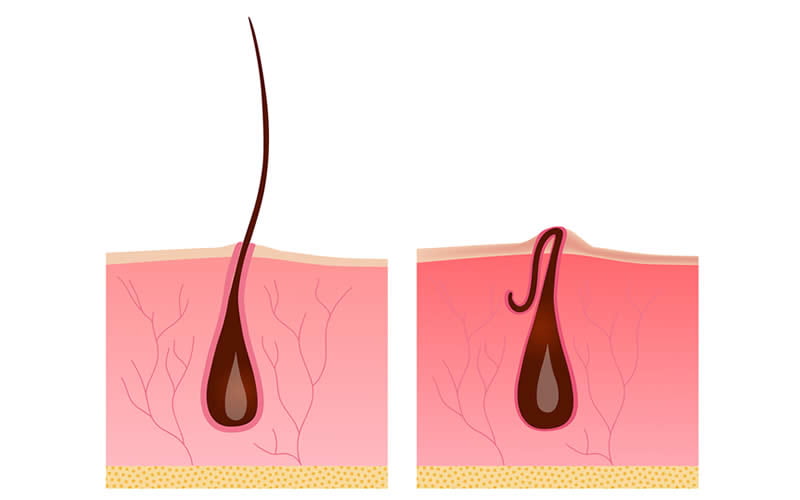
When ingrown hair develops, patients often do not notice it immediately. This condition progresses insidiously. Some symptoms may appear during the stage when hair accumulates under the skin, but these symptoms are usually mild and often ignored. As the condition progresses, patients begin to feel discomfort and eventually seek medical attention.
Common symptoms include:
- Discharge from the affected area
- Pus that may appear white or green
- Foul-smelling discharge
- In some cases, bloody discharge
- Mild to severe pain
- Redness and swelling in the affected area
The unpleasant odor is usually due to infection in the area. As bacteria multiply, the color of the discharge may turn green. When the cystic structure turns into an abscess, pain develops. Most patients seek medical attention at this stage. The pain can sometimes be severe enough to interfere with daily activities.
How Is Infected Ingrown Hair Treated?
It is often believed that infected ingrown hair can be treated with many different methods. However, treatment procedures are generally similar. Surgical intervention is usually required to treat infected ingrown hair. A small incision is made in the skin, the area is cleaned, and the procedure is completed. The recovery period is usually short. Although patients feel relief after the procedure, in about 90% of cases, the condition may recur after abscess drainage. As a result, patients may eventually require surgery.
Ingrown Hair Surgery
The most effective treatment for ingrown hair is surgical intervention. Surgery significantly reduces the risk of recurrence. Since only a small incision is made, there is no need to worry about large scars. During the procedure, the affected area is cleaned thoroughly, and then the incision is closed with sutures. The operation is performed under general or spinal anesthesia, so the patient does not feel pain during the procedure. Overall, it is a comfortable surgical process.
Sinusectomy
In some cases, the procedure can be performed under local anesthesia. Sinusectomy is a commonly preferred technique in recent years because it does not require hospitalization. It leaves minimal to no scarring, and recovery is faster. The operation usually takes between 20 and 30 minutes but may extend up to one hour in more extensive cases.
Rhomboid Flap
The affected area is removed in a diamond shape, and a flap of equal size is used to cover the defect. A drain is placed and removed after about 3 days. Sutures are usually removed after 15 days. The recurrence rate is approximately 5%.
Karydakis Flap
This technique was developed by a Greek surgeon. While similar to the flap method, it results in less visible scarring, although recurrence rates are higher.
Open Surgery
In this method, the affected area is removed and left open for dressing. The recurrence rate is higher, and the dressing process can last at least one month, which may reduce patient comfort.
Does Ingrown Hair Recur?

It cannot be said that ingrown hair will never recur after treatment. Unfortunately, there is always a risk of recurrence. However, with modern techniques, this risk has been significantly reduced. Maintaining proper hygiene is essential to minimize recurrence.
Postoperative Care After Pilonidal Sinus Surgery
After surgery, certain precautions must be followed. The recovery period may vary but generally takes between 6 to 8 weeks. In some cases, full recovery may occur within 2 to 3 weeks. Patients should pay close attention to hygiene and proper wound care at home.
If medications are prescribed, they should be taken regularly. The treated area should be kept clean and dry, and excessive sweating should be avoided. Proper hair removal methods can also help reduce recurrence risk. Depending on the procedure, temporary lifestyle adjustments such as modified sitting positions may be necessary. Following the doctor’s instructions ensures a smooth recovery.
Antibiotic Treatment for Pilonidal Sinus
Antibiotics may help reduce symptoms, but they are not sufficient when infection is present. After cleaning the infected area, antibiotics are recommended. In advanced cases, surgical treatment is necessary. A simple examination by a doctor is enough to determine the appropriate treatment method. Patients can consult their doctor for detailed information about treatment options and recovery.
How to Recognize Ingrown Hair?
This condition is often confused with other anal region diseases such as hemorrhoids, anal fissure, or anal fistula. This is because the area is not easily visible and patients may delay seeking medical help due to embarrassment. Typically, pain is felt 2–3 cm above the anus (sacrum area). Small openings may be visible in the area, and hair may be seen emerging from these openings.
Is There a Non-Surgical Treatment for Ingrown Hair?
Phenol Treatment
In early-stage cases, phenol treatment may be applied. The area is cleaned, and crystallized phenol is applied until the wound closes.
Laser Treatment
The sinus area is cleaned, and a special laser probe is used to cauterize the area. However, due to high cost, it is not widely preferred in our country.
Grades of Pilonidal Sinus
Grade 0
Grade 1
Hair has entered the sinus but has not progressed more than 1 cm. The openings are still in the midline. Occurs within about 6 months.
Grade 2
Hair sinuses extend beyond 1 cm, with occasional minor infections. Occurs within 6 months to 1 year.
Grade 3
Fistulas extend up to 6 cm, and openings increase in the midline and spread laterally up to 3 cm. Patients frequently experience abscesses. Duration is 1–5 years.
Grade 4
Fistulas extend beyond 7 cm with areas of necrosis. Continuous discharge is present. Duration is 5–15 years.
